

 9am – 5pm Eastern, Monday – Friday
 133 N Dupont Blvd Ste 103, Smyrna, DE 19977
 Sale Tax Free Shopping!
From Hard Hats to Smart Tech: How Rugged Tablets Are Redefining Safety in Heavy Industry
9th Jan 2026
Workplace Safety Is Still a Challenge
Every year, millions of workplace injuries happen, leading to both personal and financial losses. The International Labor Organization (ILO) reports1 that 2.93 million workers die each year from work-related diseases (2.6 million) and accidents (330,000), with another 395 million workers worldwide suffering non-fatal injuries.
The financial impact is significant. The ILO estimates that workplace injuries and illnesses can cost close to 6% of global GDP. In the U.S., the 2024 Liberty Mutual Workplace Safety Index reports that businesses spend over $1 billion2 each week on direct costs for serious, non-fatal injuries.
Even with years of safety rules and Personal Protective Equipment (PPE), these numbers show that traditional methods are not enough. Construction, mining, manufacturing, transportation, and oil and gas are still some of the most dangerous industries. Technology can improve safety, but only if the tools can withstand harsh industrial environments.
1https://www.ilo.org/topics-and-sectors/safety-and-health-work#
2https://business.libertymutual.com/insights/2024-workplace-safety-index/
Fortunately, rugged tablets have become powerful tools in recent years. They connect workers to essential safety systems in real time and help bring advanced technology to tough field conditions.
Why Heavy Industry Needs Technology-Enabled Safety
In heavy industry, workplaces are often challenging environments. Employees regularly perform high-risk tasks, such as working at heights, entering confined spaces, operating heavy machinery, and handling hazardous materials. A single mistake can have serious consequences.
Besides these main risks, factors such as human error, tiredness, and lack of training also cause accidents that could be avoided. Harsh conditions, such as bright sunlight, heavy rain, or thick dust, can make manual safety checks harder and interfere with them.
Research and industry data show that greater use of technology leads to better safety outcomes. For example, a 2018 study3 found that using robotics and automated vehicles, like drones for inspections, could cut workplace injuries by up to 11% by 2030.
Technology can make safety efforts more effective by providing workers with a digital safety net rather than replacing them. Switching from paper checklists to real-time, data-driven tools helps companies spot hazards early and make safety a regular practice.
3 https://publications.csiro.au/publications/publication/PIcsiro:EP185684
The Evolution of Safety Technology in the Industrial Workplace
In the past, safety mainly meant physical gear like hard hats, steel-toed boots, and high-visibility clothing. These are still important as a last line of defense, but they cannot warn workers about hazards before they happen.
Now, companies are turning to Smart PPE. Wearable devices like vests and helmets can track heart rate, body temperature, and fatigue, alerting supervisors before a worker gets heat exhaustion or becomes overworked.
There are also environmental detectors and IoT sensors that can detect gas leaks or rising radiation levels much earlier than people can, sending alerts to all nearby workers.
Progress is not only about what workers wear or use, but also about how they are trained and supported. Robotics and automation can keep people out of dangerous areas. Drones inspect high-voltage lines, and robotic crawlers check confined spaces for safety.
For training, companies are making the most of Virtual and Augmented Reality. Workers can use VR to practice emergency responses on a digital replica of their actual job site. AR can show digital blueprints or safety checklists right in a worker’s view, so they don’t miss crucial steps during complex tasks.
To get the most from these tools and avoid scattered data, field workers need a central mobile device. This is where rugged tablets come in. They can run AR apps, track data from wearables, and help with emergency communication. By bringing all this together in one tough device, they connect advanced data with real-time action.
How Rugged Tablets Have Grown Beyond “Rugged Hardware”
Early rugged devices often focused too much on durability, sacrificing performance. Now, new models combine the power of a laptop with the flexibility of a mobile device. They support advanced features, enabling workers to handle large datasets from drones or IoT sensors in the field.
These tablets also offer the latest connectivity, like WiFi 6E, 5G, and precise GPS. They include strong security features such as biometric readers and smartcard authentication.
Their screens are now easy to read in sunlight and can be used while wearing gloves. This means workers don’t have to take off protective gear and risk injury just to enter important safety information.
Rugged Tablets as a Safety Enabler In Hazardous Environments
Rugged tablets bring together different safety protocols into a single, real-time system. By connecting to IoT platforms and SCADA systems, they provide workers with instant alerts about environmental hazards. Digital workflows, such as Permit-to-Work (PTW) systems and mobile safety checklists, ensure that protocols are followed to the letter by requiring time-stamped, geo-located verification before tasks begin.
As mentioned earlier, these tablets change how workers train and prepare. Tablets that run VR let workers practice emergency responses right at the job site. If a worker has a question during a tough repair, they can quickly access 3D diagrams or get remote AR help, reducing mistakes.
Rugged tablets can also be a lifeline in emergencies. With built-in 5G and precise GPS, they allow instant communication and can track a worker’s location in case of an accident, even in large or underground sites.
A Modern Example of Tablet-Driven Safety: the Getac F110
A good example is the Getac F110. It uses 13th Gen Intel® Core™ i5/i7 processors. It can run complex safety analytics and real-time data feeds, so there’s no worry about slow emergency responses.
The F110 is built to be extremely tough, with a chassis rated for MIL-STD-810H and IP66 durability. It can handle six-foot drops and high-pressure water jets.
For work areas with flammable gases or dust, special versions like the F110-EX are certified for ATEX and IECEx Zone 2/22, so the tablet itself won’t cause ignition.
The 11.6-inch LumiBond display makes the F110 easier to use, with 1200 nits of brightness for clear viewing even in sunlight. Its touch modes also let workers use it while wearing gloves or in heavy rain.
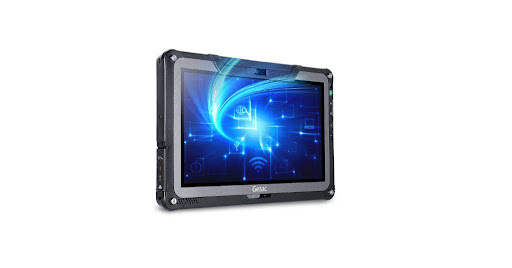
The F110 also has two hot-swappable batteries, allowing users to replace them without turning off the tablet. This helps keep operations safe and running smoothly.
With these features, one device can link workers to safety systems, training resources, and remote experts, all without adding extra risk to operations.
Final Thoughts
It’s important to remember that technology by itself is not enough. The best safety approach is still the hierarchy of controls, which aims to remove workers from hazards whenever possible.
But when people must be present, technology can strengthen safety efforts. It helps workers stay aware of their surroundings and supports a safety-first culture by making safe practices the easiest option. Leadership and culture are the foundation, but technology helps build on it.
Industries everywhere are shifting to data-driven, proactive safety. Rugged tablets play a key role in this change, connecting workers to their company’s safety systems. Companies that use these devices are not just upgrading their equipment—they are investing in their most valuable asset: their people.